
Overnight guest rules for your rental property: complete guide + policy templates
Unsure how to set overnight guest rules for your rental? Learn how to write policies that are clear, fair, and compliant, with a ready-to-use template.
“Can I have guests stay overnight?”, you’ve probably heard this question from prospective tenants. And how you answer it shapes many things: who your tenants will be, how safe your boarding house remains, and how much conflict shows up down the road.
Overnight guest rules are one of the most sensitive, and most frequently violated, topics in the rental business. Too strict, prospects leave for a competitor. Too loose, your boarding house becomes uncontrolled, safety, noise, and legal risk all creep in.
This article covers how to write guest rules that are clear, fair, and compliant with Indonesian norms, complete with a template you can adapt right away.
Why overnight guest rules matter
Before jumping into specifics, it helps to understand why this topic isn’t just a personal preference.
Safety of every resident
Any unknown guest entering the boarding house is a potential safety risk for everyone living there. Missing items, late-night disturbances, or worse incidents often involve guests who were never recorded.
Legal obligation to local authorities
In many jurisdictions, guests staying more than 24 hours should be reported to local authorities or the neighborhood registration office. An owner who doesn’t educate tenants about this can face administrative issues, or worse, if something involving an unregistered guest happens. Check what applies in your specific area.
Comfort for other tenants
A boarding house is shared living. One tenant who constantly brings guests without notice can inconvenience others, bathroom lines get longer, the kitchen gets messier, noise levels rise. Clear guest rules protect the majority’s comfort.
Legal protection for the owner
If something happens at your boarding house, theft, violence, or illegal activity, and the guest involved was never recorded, your position as owner becomes weak. Written rules + guest logging is a form of self-protection.
Guest categories that need rules
Not every guest needs the same treatment. Separate rules by category:
1. Visiting guests (not staying)
Short visits, friends dropping by, couriers delivering packages, family picking someone up. Usually enough to cover with:
- Visiting hours (e.g. 07:00–22:00)
- Must be met by, or with knowledge of, the tenant
- Not entering other tenants’ private areas
2. Occasional overnight guests
Guests staying 1–2 nights, a partner, out-of-town relatives, a college friend needing temporary shelter. Typically requires:
- Notice to the owner/caretaker before the guest arrives
- Photo of the guest’s ID for record
- Duration limits (typically max 2–3 nights in a row)
- Any extra fee provisions
- Opposite-gender rules (for single-gender boarding houses)
3. Long-term overnight guests
This is usually where problems start, a partner or friend who de facto lives there without paying. Rules here have to be firm:
- Staying more than X nights per month is not allowed
- To stay permanently, they must be counted as an additional tenant with corresponding fees
- Repeated violations can be grounds for terminating the lease
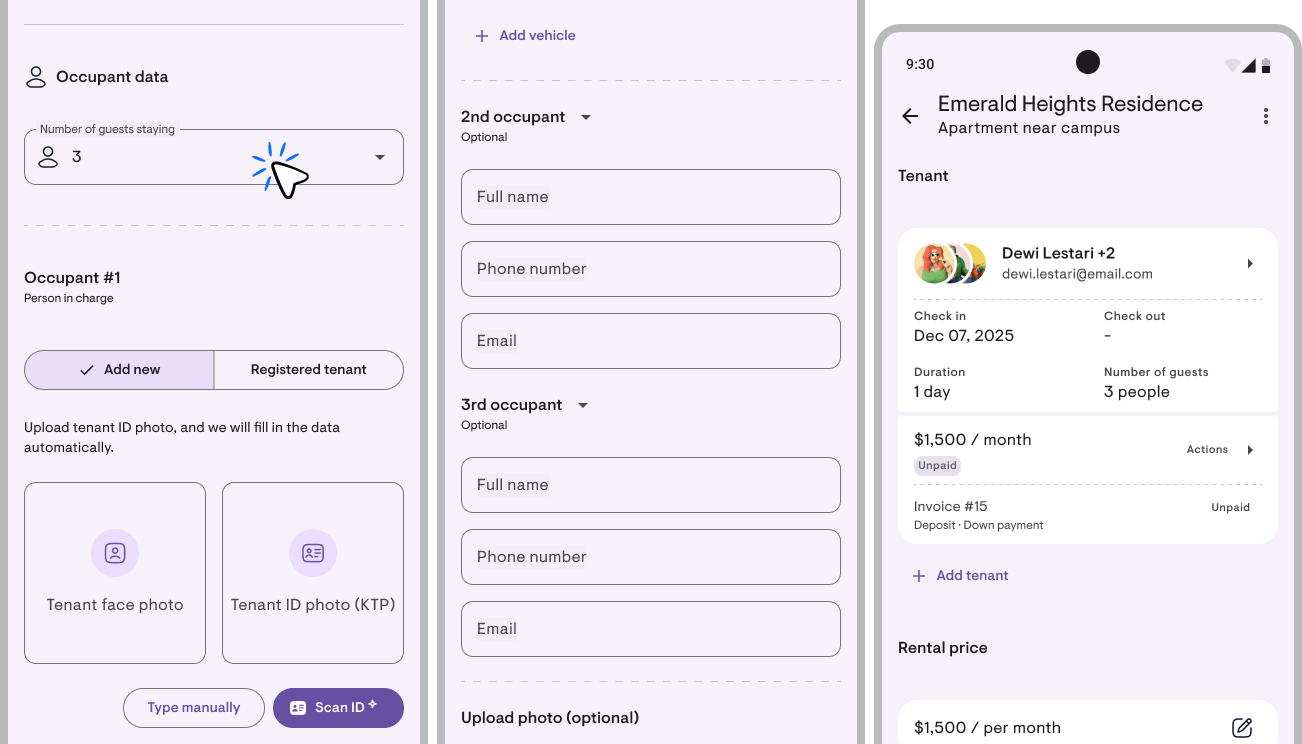
If you use an app like Kamaru, the occupant roster on each lease makes this formality easier, you can register Occupant #1 as the responsible party (the one who pays + signs the contract) plus Occupant #2, #3, etc. as additional occupants with their own ID data. Instead of letting long-term guests live in a gray zone, they’re formally recorded on the lease roster. This is a Pro feature.
4. Special guest categories
Some categories need their own rules:
- Children, consider the noise impact on other tenants
- Pets, usually requires special permission or is banned outright
- Groups / multiple guests at once, limit the number of simultaneous guests in a room
Legal rules you should know
The 24-hour reporting obligation
Many local jurisdictions require guests staying more than 24 hours to be reported to local authorities. Practice varies by area, but it’s a safe standard to adopt.
What you should do as owner:
- Tell tenants about this obligation from the start
- Provide the local authority’s contact info
- Document that the tenant has been informed (in the contract or house rules)
Guest identity data
Always ask for a photo of the guest’s ID. This is important for:
- Identity verification
- Documentation if problems arise
- Proof that you’re doing your due diligence as owner
Opposite-gender rules (for single-gender boarding houses)
If your boarding house is men-only or women-only, opposite-gender guest rules must be very clear, under social norms in many parts of Indonesia, this isn’t just a preference but can become an issue with neighbors.
Most single-gender boarding houses apply one of:
- Fully prohibited, opposite-gender guests can’t enter rooms at all
- Common area only, allowed in the living room / porch, not in bedrooms
- Time-limited, allowed during daytime with a specific cutoff
Components a complete guest policy should cover
A complete guest policy covers 8 elements:
1. Guest definition Distinguish visiting from staying overnight. Define “overnight” clearly, e.g. “being at the boarding house after 22:00 until 06:00 the next day”.
2. Notification procedure How should the tenant notify the owner/caretaker before a guest arrives? Via WhatsApp? In person? How far in advance?
3. Data that must be reported Name, relationship to the tenant, purpose of visit, duration, photo of ID.
4. Operating hours When can guests arrive and must leave (for visiting guests). Maximum check-in time for overnight guests.
5. Duration limits Max nights per visit? Total nights per month?
6. Extra fees (if any) Some boarding houses charge per night for overnight guests (typically Rp 25,000–50,000 IDR, roughly $2–3 USD). State it clearly if this applies.
7. Specific rules Opposite gender, children, pets, number of simultaneous people.
8. Consequences of violations Warnings, fines, or even contract termination. Must be clear from the start.
Example guest policy template
Here’s a template you can adapt to your boarding house:
GUEST RULES, [KOS NAME]

A. VISITING GUESTS (NOT STAYING OVERNIGHT)
1. Visiting hours: 07:00 – 22:00
2. Guests must be met directly by the tenant they're visiting
3. Guests are not permitted to enter other tenants' rooms
4. For [male/female]-only boarding houses: [opposite-gender] guests are
   only allowed in common areas, not in bedrooms

B. OVERNIGHT GUESTS
1. Notify the manager at least 6 hours before the guest arrives
   via WhatsApp to [manager number]
2. Report: name, relationship, stay duration, and photo of ID
3. Maximum stay: 2 nights in a row, max 4 nights per month
4. Overnight guest fee: Rp [amount]/night (optional, remove if free)
5. For [male/female]-only boarding houses: opposite-gender guests
   ARE NOT allowed to stay overnight under any circumstances

C. TENANT RESPONSIBILITIES
1. The tenant is fully responsible for their guest's behavior
2. Damage or losses caused by the guest are the tenant's
   responsibility
3. Guests must comply with all applicable house rules

D. LOCAL AUTHORITY REPORTING
Per local regulations, guests staying more than 24 hours
will be reported to local authorities. Guest data will be
used for this purpose.

E. VIOLATION CONSEQUENCES
- Violation 1: Verbal warning
- Violation 2: Written warning + fine of Rp [amount]
- Violation 3: Lease termination without deposit refund

I, [Tenant Name], understand and agree to the rules above.

Date: __________
Signature: __________
Adjust numbers, hours, and details to your boarding house. What matters: rules must be written and signed by the tenant at check-in, not conveyed verbally.
After signing, keep the digital copy. In Kamaru, you can upload the signed contract + house rules to the additional documents slot in each tenant’s profile, attached to the tenant record, safe in the cloud, accessible whenever a dispute arises (see the complete guide to managing tenant documents digitally). The additional slot is a Pro feature.
How to socialize the rules
Good rules don’t matter if tenants don’t understand them. Do these four things:
1. Include in the lease contract
Guest rules should be part of what tenants sign at check-in, not an optional attachment. This gives it legal weight if a dispute arises.
2. Post in common areas
Print a short version and post it somewhere visible, the living room, near the entrance, or in the tenants’ WhatsApp group.
3. Explain in person at check-in
Don’t rely on text alone. Take 5 minutes at check-in to walk through the key points, especially notification procedure, duration limits, and consequences.
4. Send periodic reminders
Send reminders in the tenants’ WhatsApp group every 3–6 months, especially before holidays or moments when guests tend to spike (like before major public holidays, New Year, or campus exam season).
How to handle violations
Even with clear rules, violations will happen. What matters is handling them consistently.
Step 1: Confirm first, don’t accuse
Before confronting, make sure you have evidence. CCTV footage, reports from other tenants, or direct observation. Accusing without evidence can damage the relationship with a tenant who’s actually innocent.
Step 2: Clear verbal warning
For a first violation, talk directly to the tenant. Explain what rule was broken, the impact, and the consequence if it repeats. Keep a note that the warning was given.
Step 3: Written warning
If it repeats, give a written warning (WhatsApp with read receipt is fine). This becomes formal documentation you can use if lease termination is needed.
Step 4: Fine or lease termination
For serious or repeat violations, apply the consequences you defined. Consistency is key, if you don’t enforce the rule on one tenant, others will assume it doesn’t apply.
Read the full guide: How to handle problem tenants professionally.
FAQ
Is the landlord required to report tenants’ guests to local authorities?
Practice varies by area. Generally, reporting guests staying more than 24 hours is the tenant’s obligation (not the owner’s), but the owner must facilitate and make sure tenants know the rule. Always coordinate with your local neighborhood office to learn the specific procedure in your area.
Is it okay to forbid overnight guests entirely?
Yes, and this is a valid policy. As long as it’s communicated up front (before the contract is signed), prospective tenants have the choice to accept or look elsewhere. What’s not okay is changing the rule mid-contract without the tenant’s consent.
What if the guest is a legal partner (spouse)?
For single-gender boarding houses, the policy usually still applies, a boarding house isn’t a family residence. If a tenant marries and the spouse wants to move in, the options are moving to a different housing type (contract house / boarding) or looking for a family boarding houses.
What’s a reasonable fine for overnight guest violations?
Typically Rp 100,000–300,000 (roughly $7–20 USD) per violation. More important than the amount is consistency of enforcement. A fine that’s always applied is more effective than a big fine that’s rarely collected.
Can I make different rules for VIP or long-time tenants?
Better not to. Differentiated rules between tenants are a recipe for conflict. What you can do is give flexibility in exceptional cases (e.g. a tenant’s family member is ill), but always within the same rule framework.
Conclusion
Good overnight guest rules aren’t about restricting tenant freedom, they’re about creating an environment that’s safe, comfortable, and orderly for everyone in the boarding house. Clear rules actually protect the good tenants from the problematic ones.
The keys:
- Rules must be written and signed at check-in
- Details must be specific, avoid words that can be interpreted differently
- Regular socialization, post in common areas, remind in the WhatsApp group
- Consistent enforcement, a rule not enforced is worse than no rule
- Complete documentation, photo of guest ID, notification records, violation history
To make tenant and guest documentation easier, Kamaru provides a centralized place to store ID photos, important notes, and tenant history, all in one app, safely in the cloud.
Related articles
Have questions or feedback? We'd love to hear from you. Email us.

Start managing for free today
Join other landlords who are already using Kamaru to manage their properties.

